Blog

  • “From customer service to complex banking tasks” DeepBrain AI implements AI human technology into KB Kookmin Bank

    “From customer service to complex banking tasks” DeepBrain AI implements AI human technology into KB Kookmin Bank

    DeepBrain AI, a company specializing in artificial intelligence(AI), announced on the 28th that it has signed a technology supply agreement with KB Kookmin Bank, a leading financial company, and implemented Korea’s first kiosk-type ‘AI banker’ and officially introduced it this month.

    Since March of last year, DeepBrain AI has been working closely with AI bankers to improve functions and enhance performance by piloting AI bankers in the AI experience zone located at KB Kookmin Bank’s Yeouido headquarters. As a result, it succeeded in commercializing AI human-based kiosk products for the first time in Korea, drawing great attention from the IT industry as well as the financial sector.

    DeepBrain AI’s AI human technology is a solution that creates a virtual human capable of real-time interactive communication. It implements AI that can communicate directly with users by fusion of speech synthesis, video synthesis, natural language processing, and speech recognition technologies. As a technology that can realize complete contactless service in various fields, banks have the effect of providing a secure counseling service to customers who prefer non-face-to-face in accordance with the COVID-19 situation, and shortening customer waiting time through faster response.

    First, the AI banker greets customers when they arrive at the kiosk and provides answers to their questions. All answers go through the process of deriving optimal information based on KB-STA, a financial language model developed by KB Kookmin Bank, and delivered to customers through the AI banker’s video and voice implemented with DeepBrain AI’s AI human technology.

    Specifically, it is possible to guide how to use peripheral devices such as STM (Smart Automated Machine), ATM (Automated Machine), and pre-writing service, introduce financial products, and guide the location of the kiosk installation point. In addition, it is loaded with information on convenience of living such as financial common sense, today’s weather, and surrounding facilities.

    In addition, the AI banker, with idle-mode, can make natural gestures such as moving hands, nodding, and tidying up clothes during conversation maximizing user experience from the customer’s point of view. In addition, it is possible to recognize people through the front camera, so if a customer leaves their seat, the kiosk is automatically finished as a thank you.

    This time, KB Kookmin Bank’s AI banker modeled and implemented one male and one female model, and utilized their actual audio and video data. In the case of clothes, the main colors of KB Kookmin Bank are yellow and gray, so that the brand image can be recognized by customers while using the kiosk.

    DeepBrain AI CEO Eric Jang said, “The AI banker has endless possibilities that can be used for customer service with a variety of devices such as mobile devices as well as kiosks in the future. Based on DeepBrain AI’s recognized AI human technology and business value, we will continue to explore business routes so that it can be applied to more diverse fields.”

  • Vectra AI Appoints Willem Hendrickx as Chief Revenue Officer

    Vectra AI Appoints Willem Hendrickx as Chief Revenue Officer

    San Jose, Calif. — February 2022

    Vectra AI, a prominent leader in AI-driven threat detection and response for hybrid and multi-cloud enterprises, has officially announced the appointment of Willem Hendrickx as its new Chief Revenue Officer (CRO). This executive shift follows a year of exceptional growth for the company, driven by the accelerating global demand for advanced threat detection solutions.

    The New CRO: Willem Hendrickx

    In his new role as CRO, Hendrickx will take charge of Vectra’s global expansion initiatives while managing the entire lifecycle of its customers and partners. He is no stranger to the company, having previously served as Vectra’s Senior Vice President, International. During his tenure as SVP, he played a crucial role in transforming and expanding business operations across the EMEA (Europe, Middle East, and Africa) and APJ (Asia-Pacific and Japan) regions.

    Hendrickx brings more than 25 years of experience in global software sales to the executive team. Throughout his career, he has held significant leadership positions at major technology companies, including:

    • EMC / Dell
    • Nokia
    • Alcatel-Lucent
    • Riverbed Technology

    “The enterprise security market continues to move away from legacy preventative security solutions – and towards the advanced detection and response capabilities necessary to stop attackers in their tracks,” said Hendrickx regarding his new role. “Vectra continues to establish itself as a leading vendor to protect against the next wave of threats, and I am looking forward to continuing to grow our operations in existing and new regions”.

    Leadership Perspectives on Global Expansion

    Vectra AI’s President and CEO, Hitesh Sheth, highlighted the urgency of the current cybersecurity landscape as a major driver for the company’s momentum.

    “In recent months, we have witnessed some of the most detrimental cyberattacks in our history,” Sheth noted. “Enterprises across the globe are rapidly adopting and deploying detection and response solutions to provide coverage across cloud, data center and SaaS environments”.

    Sheth expressed his enthusiasm for Hendrickx’s promotion, stating that he will be instrumental in scaling the business globally and fostering a culture of disruptive and innovative thinking.

    Strategic Moves: The Siriux Acquisition

    Hendrickx takes over the CRO position from his predecessor, Marc Gemassmer. After successfully guiding Vectra AI through 20 months of high growth, Gemassmer is transitioning to a newly created role as the General Manager of Vectra’s identity and software as a service (SaaS) posture management business.

    This transition directly supports Vectra’s recent acquisition of Siriux Security Technologies in January 2022. Gemassmer will partner with Aaron Turner, the founder and CEO of Siriux, to lead Vectra’s push into this critical new market.

    Gemassmer emphasized the importance of this new direction, noting that the SaaS attack surface is expanding exponentially. The integration of Siriux positions Vectra AI as a unique vendor capable of securing SaaS configurations while unifying them with the active detection and response of threats within SaaS applications.

  • Remote Health Monitoring Global Market Report 2023: Promises vs. Reality

    Remote Health Monitoring Global Market Report 2023: Promises vs. Reality

    When the Remote Health Monitoring Global Market Report 2023 was published, the healthcare industry was at a critical crossroads. Emerging from the peak pandemic years, the report projected massive, sustained acceleration for Remote Patient Monitoring (RPM).

    But did those market predictions hold true?

    Looking back from 2026, we can see that while the 2023 report accurately called the massive upward trajectory of telehealth, it actually underestimated how deeply technology—specifically artificial intelligence and the Internet of Medical Things (IoMT)—would rewrite the rules of modern patient care.

    1. The 2023 Baseline: What the Report Predicted

    In 2023, analysts highlighted several structural shifts driving the global remote health monitoring market. The core thesis was simple: an aging global population and a rising tide of chronic illnesses were pushing traditional hospital infrastructure to its absolute limits.

    Persistence Market Research

    The report identified three main pillars of growth:

    • The Chronic Disease Surge: Managing long-term conditions like hypertension, diabetes, and cardiovascular disorders outside of the clinic. Persistence Market Research
    • The Post-Acute “Hospital-at-Home” Shift: Moving recovering patients out of expensive ICU beds and into home environments with connected monitors. Persistence Market Research
    • The Domination of North America: Driven by early adoption and progressive reimbursement frameworks from the Centers for Medicare & Medicaid Services (CMS). Persistence Market Research
    Remote Health Monitoring Report 2023

    2. Market Evolution: The Numbers Today

    The projections made in 2023 laid the groundwork for a market that has expanded rapidly. Current industry data shows that the global remote patient monitoring market size has grown from roughly $55.2 billion into a commanding $67.3 billion industry, on a clear trajectory to exceed $117 billion into the next decade.

    Persistence Market Research

    Key Market Indicators At an Glance

    Market Metric2023 Legacy BaselineCurrent MomentumLong-Term Projection (2033)
    Global Market Size~$44.2 Billion$67.3 Billion$117.9 Billion
    Dominant RegionNorth America (~40%)North America (41-44%)Asia-Pacific (Fastest Growing)
    Leading Clinical SegmentDiabetes / Blood GlucoseDiabetes & CardiovascularAI-Triage & Predictive Analytics
    Average Market CAGR~12.5%15.4%8.3% (Stabilizing)

    3. Where the 2023 Projections Missed the Mark (The Surprises)

    While the financial growth metrics aligned closely with the 2023 report’s expectations, the nature of the technology shifted much faster than anticipated.

    The AI and Contactless Revolution

    In 2023, remote monitoring still heavily relied on a patient manually wrapping a blood pressure cuff around their arm or placing a finger in a pulse oximeter. Today, the market has pivoted toward contactless, continuous monitoring.

    Persistence Market Research

    💡 Real-World Impact: Solutions hitting the market allow clinicians to perform 30-to-60-second “selfie scans” via tablet or smartphone, using advanced optical AI to capture heart rate variability, respiration rates, and blood pressure entirely touch-free.

    The Interoperability and Workflow Bottleneck

    The 2023 report championed data collection, but it failed to anticipate the severe “alert fatigue” hitting healthcare workers. The massive influx of raw, continuous patient data overwhelmed hospital Electronic Health Records (EHR) systems. This forced a massive secondary market shift toward intelligent triage software—software that filters out harmless data spikes and only alerts doctors when a patient is genuinely in danger.

    4. Driving Forces Behind Ongoing Growth

    The underlying drivers of the remote health monitoring sector remain remarkably consistent, though amplified by recent global events:

    • Demographic Strain in Europe and Asia: Europe’s aging population (with over 21% of the EU population over age 65) and a massive nursing shortage have forced healthcare systems in Germany, France, and Spain to heavily subsidize digital health applications to prevent hospital overcrowding.
    • Macroeconomic Pressures: Global semiconductor shortages and shifting trade tariffs have increased the cost of manufacturing raw physical hardware. This has inadvertently accelerated the software-as-a-service (SaaS) side of RPM, pushing companies to develop smarter software that utilizes existing consumer hardware like Apple Watches or Android devices. Research and Markets

    The Takeaway

    The Remote Health Monitoring Global Market Report 2023 correctly diagnosed a massive market need. However, the future didn’t just bring more of the same medical devices; it brought a smarter, more integrated ecosystem. For healthcare providers and investors, the lesson of the last three years is clear: success in the RPM space is no longer just about hardware—it is entirely about intelligent data integration, ease of use, and automated, actionable clinical insights.

  • Philips’ Future Health Index 2020 report reveals new insights into younger doctors’ commitment to improving healthcare during COVID-19

    Philips’ Future Health Index 2020 report reveals new insights into younger doctors’ commitment to improving healthcare during COVID-19

    • 61% of younger doctors ranked telehealth as the digital health technology that would have most improved their experiences during COVID-19, overtaking artificial intelligence (AI) (53%)
    • 47% of younger doctors reported greater appreciation from patients; 44% experienced greater collaboration with colleagues across different skill sets
    • Only 9% of younger doctors surveyed are more likely to leave medicine as a result of their experiences during COVID-19, while over one third (38%) are more likely to stay

    Amsterdam, The Netherlands – Royal Philips (NYSE: PHG, AEX: PHIA), a global leader in health technology, today announced the results of its latest piece of Future Health Index (FHI) 2020 research. The Future Health Index Insights: COVID-19 and Younger Healthcare Professionals survey supplements the main FHI 2020 report, capturing feedback from 500 doctors under the age of 40 in five countries: the United States of America, China, Singapore, France and Germany. The findings reveal how the COVID-19 pandemic has affected the attitudes and experiences of younger doctors, and how they believe the healthcare industry should change in response.

    “Healthcare professionals, including the younger generation, have experienced unprecedented levels of stress and were often faced with limited resources in recent months. We must acknowledge the heroic sacrifices that frontline healthcare professionals have endured in the fight against COVID-19. We owe it to them to listen to their voices as we consider the future of the healthcare industry,” said Jan Kimpen, Chief Medical Officer, Royal Philips. “Our FHI Insights survey reveals that despite the challenges they’ve faced, younger doctors are as committed as ever to their vocation. The research spotlights how young doctors perceive change, and is relevant to leaders focused on reshaping how healthcare is being organized and delivered.”

    Telehealth overtakes AI in the eyes of younger doctors
    The COVID-19 pandemic has prompted younger doctors to change their attitudes to the relative benefits of different health technologies. It has led to a shift in priorities, with younger doctors recognizing the immediate value of telehealth. Before the pandemic, 60% of younger healthcare professionals ranked AI as the top digital health technology that would most improve their work satisfaction, with 39% identifying telehealth as the top technology. 61% of younger doctors now rank telehealth as the digital health technology that would have most improved their experiences at this time, with AI falling to 53%.

    Younger doctors surveyed believed that there is room for improvement in how these technologies are used in everyday practice. When asked what would have helped them leverage the health data available to them during the height of the pandemic, nearly half (47%) of younger doctors pointed to better integration of healthcare data between hospitals/practices and between different IT systems or electronic medical records.

    Younger doctors want more digital technology
    For many younger doctors, working through COVID-19 has shown what a more technologically forward-thinking workplace could look like, with 44% reporting the pandemic exposed them to new ways of using digital health technologies.

    As the healthcare sector prepares for the future, many younger doctors hope these advancements will become permanent fixtures of their post-COVID-19 workplace environments. When asked what changes in healthcare they most hoped would become outlast the pandemic, younger doctors ranked exposure to new types of digital health technologies (29%), new ways to use digital health technologies (29%), greater appreciation from patients (29%), and accelerated availability of digital health technologies (28%) as their top responses. 

    Many younger doctors are more committed than ever to their careers
    The pandemic is presenting healthcare professionals with even greater workplace hardships and moral dilemmas, which are very likely to exacerbate existing levels of burnout and related mental health problems [1]. However, according to the FHI 2020 Insights survey, many younger doctors (38%) say they are more likely to stay in medicine as a result of their experiences working during COVID-19. Most (53%) said COVID-19 had no effect on them wanting to stay in or leave the profession, and only 9% said they were more likely to leave the profession.

    Many younger doctors also reported changes in their day-to-day work during the pandemic, which could lead to increased career and personal satisfaction. 47% reported greater appreciation from patients, while 44% experienced greater collaboration with colleagues across different skill sets. Younger doctors in China stood out by reporting a deeper feeling of purpose at work (70%) since the onset of COVID-19.

    Since 2016, Philips has conducted original research to help determine the readiness of countries to address global health challenges and build efficient and effective healthcare systems. For details on the Future Health Index methodology and to access the 2020 report in its entirety, including the FHI Insights: COVID-19 and Young Healthcare Professionals research, visit the Future Health Index site.

    [1] National Academy of Medicine: https://nam.edu/initiatives/clinician-resilience-and-well-being/clinician-well-being-resources-during-covid-19/

    Research methodology
    The Future Health Index Insights: COVID-19 and Younger Healthcare Professionals survey was fielded from June 19 to July 30, 2020 in 5 countries (China, France, Germany, Singapore and the United States of America) in their native language. The survey was conducted online and offline (as relevant to the needs of each country) with a sample size of 100 per country for doctors under 40 years old, who have completed their first medical degree. The survey length was approximately 10 minutes. The total sample from the survey includes 500 doctors under 40 years old.

    For further information, please contact: 

    Kathy O’Reilly 
    Philips Global Press Office 
    Tel. : +1 978-221-8919 
    E-mail : kathy.oreilly@philips.com 
    Twitter: @kathyoreilly

    Joost Maltha
    Philips Global Press Office
    Tel. : +31 6 10 55 8116
    E-mail : joost.maltha@philips.com
    Twitter: @joostmaltha

    About Royal Philips 
    Royal Philips (NYSE: PHG, AEX: PHIA) is a leading health technology company focused on improving people’s health and enabling better outcomes across the health continuum from healthy living and prevention, to diagnosis, treatment and home care. Philips leverages advanced technology and deep clinical and consumer insights to deliver integrated solutions. Headquartered in the Netherlands, the company is a leader in diagnostic imaging, image-guided therapy, patient monitoring and health informatics, as well as in consumer health and home care. Philips generated 2019 sales of EUR 19.5 billion and employs approximately 81,000 employees with sales and services in more than 100 countries. News about Philips can be found at www.philips.com/newscenter.

  • Insight Engines Market size to exceed $11Bn by 2032, Says Graphical Research Powered by GMI

    Insight Engines Market size to exceed $11Bn by 2032, Says Graphical Research Powered by GMI

    The insight engines market valuation is poised to reach USD 11 billion by 2032, as reported in a research study by Global Market Insights Inc.

    Increasing advancements in AI and machine learning technologies for the influx of more advanced insight engines will drive the market demand. These technologies not only assist organizations in analysing large amounts of data quickly and accurately but also offer valuable insights for business decision-making. Of late, the demand for search technologies is growing for delivering personalized results to cater to specific user needs. The rising popularity of personalized search experiences is further enhancing the industry outlook.

    The insight engines market from the on-premise segment is poised to record over 20% CAGR from 2023 to 2032. The growth can be attributed to the robust abilities of on-premise insight engines to provide customization and greater flexibility when compared to cloud-based solutions. The increasing inclination of various organizations in managing on-premise data for compliance and security reasons will also play a key role in the market expansion.

    Request for a sample of this research report @ https://www.gminsights.com/request-sample/detail/5711

    Insight engines market from the IT telecom end-use segment is estimated to cross USD 2.5 billion by 2032, owing to rising complexity as well as volume of data generated by several companies worldwide. The massive data generated by IT companies from several sources including network logs, social media system events, and customer interaction needs to be analyzed quickly. To that end, the growing adoption of insight engines will add to the industry demand.

    Asia Pacific insight engines market is expected to be worth USD 3 billion by 2032. This can be ascribed to the rising adoption of various technologies in countries, such as China and India. The rapidly expanding manufacturing sector in APAC has steered the higher focus on improving product quality. The increasing empasis of various countries on using deploying technologies to extract insights from several forms of data will also push the regional market growth.

    Make an inquiry for purchasing this report @ https://www.gminsights.com/inquiry-before-buying/5711

    Prominent participants operating across the insight engine market are Attivio, Celonis, Coveco Solutions, Inc., Micro Focus International, Elastic, Fosfor, Mindbreeze, Sinequa SAS, Funnelback Pty Ltd, Google LLC, IBM, IntraFind, LucidWorks, Inc., Microsoft, Squirro, and Stravito AB. These industry entities are focusing on partnerships and acquisitions to widen their global presence. For instance, Mindbreeze, in February 2022, joined forces with BLUE Consult GmbH for developing the InSpire solution to assist other organizations in deploying information efficiently and gaining competitive advantages.

    Partial chapters of report table of contents (TOC):

    Chapter 2   Executive Summary
    2.1    Insight engines market 360º synopsis, 2018 – 2032
    2.2    Business trends
    2.2.1    Total Addressable Market (TAM)
    2.3    Regional trends
    2.4    Component trends
    2.5    Deployment type trends
    2.6    Enterprise size trends
    2.7    End use trends
    2.8    Application trends
    Chapter 3   Insight Engines Market Insights
    3.1    Impact on COVID-19
    3.2    Russia- Ukraine war impact
    3.3    Industry ecosystem analysis
    3.4    Vendor matrix
    3.5    Profit margin analysis
    3.6    Technology & innovation landscape
    3.7    Patent analysis
    3.8    Key news and initiatives
    3.9    Regulatory landscape
    3.10    Impact forces
    3.10.1    Growth drivers
    3.10.1.1    Rising volume of data and necessity of structured data
    3.10.1.2    Advancements in artificial intelligence and machine learning
    3.10.1.3    Growing importance of knowledge management in organizations
    3.10.1.4    Need for predictive analytics to enable proactive decision making
    3.10.2    Industry pitfalls & challenges
    3.10.2.1    Concerns regarding quality of data and its source validation
    3.10.2.2    Privacy and security concerns and high cost
    3.11    Growth potential analysis
    3.12    Porter’s analysis
    3.13    PESTEL analysis

    Browse our Reports Store – GMIPulse @ https://www.gminsights.com/gmipulse 

    Browse Related Reports:

    Social Media Management Market Size – By Component (Solution, Service), By Deployment Model (On-premises, Cloud), By Organization Size (SMEs, Large Enterprises), Application, End-use & Global Forecast, 2023 – 2032.

    https://www.gminsights.com/industry-analysis/social-media-management-market

    Virtual Event Platform Market Size – By Component (Software, Service), By Organization Size (Small, Medium, and Large), By End Use (Government, Education, Healthcare, Event Management Agencies, Enterprises) & Forecast, 2023 – 2032.

    https://www.gminsights.com/industry-analysis/virtual-event-platform-market

    About Global Market Insights Inc.

    Global Market Insights Inc., headquartered in Delaware, U.S., is a global market research and consulting service provider, offering syndicated and custom research reports along with growth consulting services. Our business intelligence and industry research reports offer clients with penetrative insights and actionable market data specially designed and presented to aid strategic decision making. These exhaustive reports are designed via a proprietary research methodology and are available for key industries such as chemicals, advanced materials, technology, renewable energy, and biotechnology.

  • Telemedicine Cart Market Size Hit Around US$ 1740 Mn By 2026

    Telemedicine Cart Market Size Hit Around US$ 1740 Mn By 2026

    Acumen Research and Consulting, Recently Published Report On “Telemedicine Cart Market Size, Share, Growth Opportunities, Trends and Forecast, 2019 to 2026”.

    LOS ANGELES, Feb. 05, 2020 (GLOBE NEWSWIRE) — The global telemedicine cart market is expected to reach the market value of around US$ 1740 Mn by 2026 and is anticipated to grow at a CAGR of around 22% in terms of revenue during the forecast period 2019 – 2026.

    Increasing technical research and development in the telemedicine industry is improving the overall telemedicine cart business. Increasing demand for rural health-care services and rising government initiative. Growth in the telemedicine carts industry is due to increasing use of home monitoring devices, and increased benefits for chronic disease patients. Increasing small-scale production cooperation with large-scale manufacturers providing better investment opportunities in the forecast period would fuel the telemedicine cart industry.

    Market Drivers and Challenges

    Increasing costs for hospital treatment services is a major factor driving market demand. The rise in the incidences of chronic diseases worldwide is directly ascribed to help this market’s growth. Increasing prevalence for effective treatment procedures in rural areas propels the telemedicine market’s growth rate. The use of electronic health records in every hospital where a provider is able to browse patient health data everywhere increases market demand.

    Nevertheless, the cost of installing and managing monitoring devices is a bit costly and this aspect steadily hampers market demand. The lack of skilled individuals in evaluating the case from remote locations impedes the market’s growth rate. Rapid changes in the economic strategies can restrict telemedicine market demand. The government’s stringent rules and regulations regarding the launch of new applications are a challenging attribute to market developers.

    View Detail Information with Complete TOC@ https://www.acumenresearchandconsulting.com/telemedicine-cart-market

    Regional Outlook

    North America held significant share in global telemedicine cart market and anticipated to continue its dominance over the forecast time span. Rising spending on health care would increase demand for price-sensitive alternatives. The increasing number of telemedicine payment providers would accelerate acceptance of the system. In addition, an increasing market propensity towards home care and a participation of key players in the region would lead to the growth of the regional sector.

    Asia Pacific is projected to grow at fastest CAGR during forecast period. The region represents a large percentage of the global population, the majority of who reside in rural areas. Increasing complexity of telecommunications services, coupled with increased internet penetration, should prove conducive to growth in the sector. In addition, government initiatives fostering telemedicine development will increase the adoption of telemedicine solutions. These factors will boost Asia Pacific’s market share for the telemedicine cart. Due to shortage of resources and structural hurdles, Latin America and Middle East & Africa anticipated to show slow growth trend in the estimated year 2019-2026.

    About the Market

    Telemedicine carts have the potential to help promote health services delivery to regions that lack facilities for the diagnosis of major diseases. Modern advances in electronic communication technologies have seen improvements in various telemedicine operating systems. Telemedicine carts can be used for various purposes, such as health, medical and logistical purposes, which will create enormous potential for the telemedicine carts industry to expand in the coming years. With the popularity and growth of artificial intelligence utilization in several fields such as telemedicine in the future will spur the telemedicine cart market.

    Key Players & Strategies

    Top companies operating in the global market are AMD Global Technologies, American Well, Ergotron, Poly, Parsys, and others.

    2019, The Polycom and Plantronics merged to form Poly. This will allow Plantronics access to audio capabilities from Polycom which will be built into their telemedicine solutions. But Poly extended its activities by combining the best of its technologies.

    The report is readily available and can be dispatched immediately after payment confirmation.

    Buy this premium research report@ https://www.acumenresearchandconsulting.com/buy-now/0/1731

    If you would like to place an order or have any questions, please feel free to contact at sales@acumenresearchandconsulting.com | +1 407 915 4157 OR +1 408 900 9135

    For Latest Update Follow Us:

    https://www.facebook.com/acumenresearchandconsulting
    https://www.linkedin.com/company/acumen-research-and-consulting
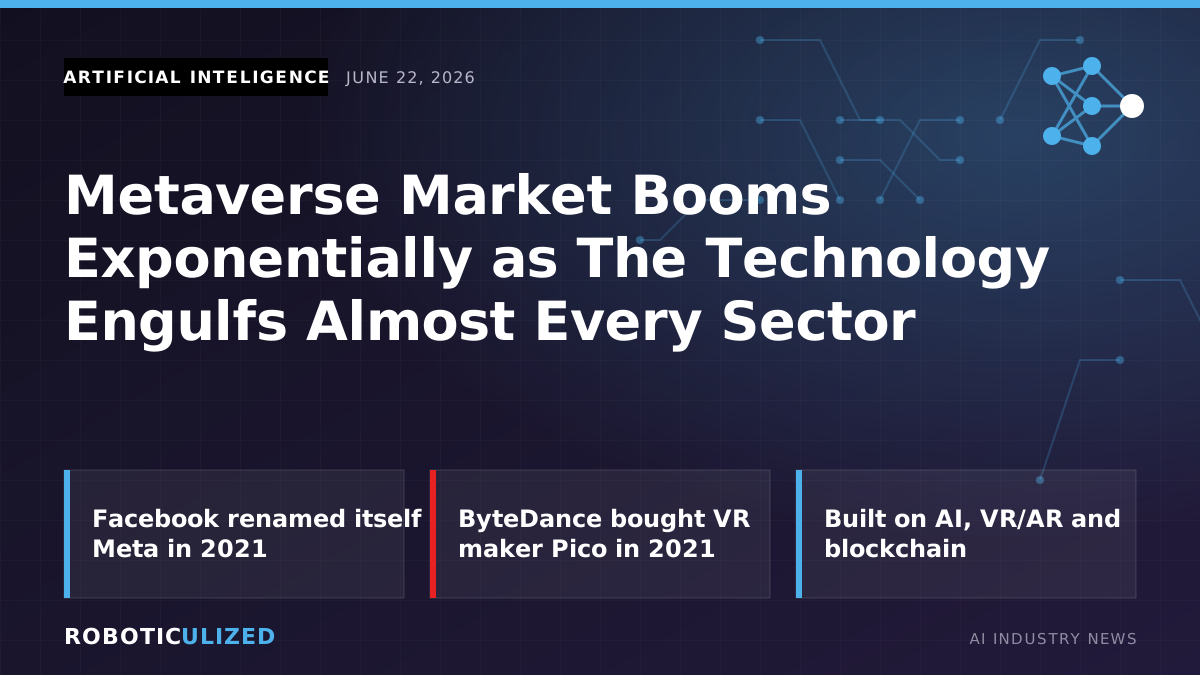
  • Metaverse Market Booms Exponentially as The Technology Engulfs Almost Every Sector

    Metaverse Market Booms Exponentially as The Technology Engulfs Almost Every Sector

    The metaverse technology is the next big platform that has managed to attract social networks, online game makers, and various technology leaders all around the world. Social, shared, virtual, persistent 3D worlds, this technology is the convergence of the digital and physical realms within the next evolution of not only the internet but social networks as well, with the use of real-time 3D software. Metaverse Market Size to reach USD 105,597.5 million, growing at a compound annual growth rate of 45.2% by 2030.

    Metaverse Market Capitalization:

    MetricDetails
    Market Cap$1,247,075,553,360
    DominanceETH: 17.6%
    BTC: 46.5%
    Exchanges527
    Cryptos19780
    ETH Gas72 Gwei
    24h Volume$90,818,657,101
    Market SizeUSD 105,597.5 Million
    CAGR45.2%
    Base Year2020
    Forecast Period2024-2030
    Historical Data2018-2019
    Forecast UnitsValue USD Billion
    Segments CoveredBy Component (Hardware and Software)
    By Platform (Desktop/ Laptops, Mobiles and Wearables)
    By Technology (Blockchain, VR & AR, Mixed Reality and Others)
    By Application (Gaming, Online Shopping, Content Creation, Social Media and Others)
    By End User (Consumer and Enterprises [BFSI, Retail, Media & Entertainment, Education, Real Estate, Aerospace & Defense, Healthcare, Engineering, and Others])
    Geographies CoveredNorth America (US, Canada, and Mexico)
    Europe (UK, Germany, France, Rest of Europe)
    Asia-Pacific (China, Japan, India, and Rest of Asia-Pacific)
    Middle East & Africa
    South America
    Key VendorsMeta Platforms Inc., Nvidia, Microsoft Corporation, Tencent Holdings Ltd., Bytedance, Epic Games, Netease Inc, Roblox Corporation, Lilith Games, Nextech AR Solutions Inc., Unity Software Inc.
    Key Market DriversIncreasing Focus on Converging Digital and Physical Worlds Using Internet
    Increasing Traction and Popularity of Mixed Reality (MR)
    Cyber-Threats

    Metaverse offers an opportunity to the top online social media and entertainment companies to leverage the emerging revenue streams. With video game developers working on elevating the existing titles into the 3D online space that are similar to social networks, their business opportunity will rise to encapsulate live entertainment including sports events and concerts and also trying to capture a share of the social-media advertising space.

    Metaverse is a virtual world where the users can go to work, shop, experience virtual trips, play games, establish communities, and also host numerous activities. Modern technologies including 5G should accelerate the power and speed needed for the digital worlds to carry on, which would encourage metaverse market growth.

    Market USP Exclusively Encompassed:
    Market Drivers
    The massive popularity of NFTs (non-fungible tokens), 3D avatars, immersive gaming and cryptocurrencies will create lucrative opportunities for the leading firms in the metaverse industry. To illustrate, Roblox lets anyone form their own worlds within its extensive metaverse space as an online crypto gaming platform as well as game creation system. Sony Music, Hot Wheels and Nerf are some of the brands that are Roblox’s partners and are creating their own immersive worlds that helps them elevate customer engagement. Microsoft, Facebook, Google and Zoom are making significant investments in the development of the metaverse technology.

    The surging emphasis on the integration of the physical and digital worlds using the internet, combined with the increasing traction of mixed reality, should foster the metaverse market size. Various businesses across North America are extensively using advanced 3D simulation, augmented reality and virtual reality to enhance their operations. Technologies like 5G, AI and Extended Reality will be making the metaverse technology futuristic, from business intelligence standpoint.

    What are the Primary Applications of Metaverse?
    The metaverse technology has a series of significant applications, some of which are online shopping, gaming, social media, content creation, and more.

    Metaverse Applications in Online Shopping
    Metaverse in the e-commerce sector has been a major hit. The technology’s adoption continues to mount, ushering in new advanced features that integrate online shopping with offline shopping. The huge demand for the augmented reality technology enables the consumers to be completely assured of the fit and quality of the product before purchasing. This allows the shoppers to have a convenient experience while helping the merchants to enhance their returns and expand their customer base.

    Product discovery as well as personalization are fostered by the metaverse technology as well, as it allows the brands to provide the shoppers a personalized digital experience. Metaverse facilitates a seamless shopping experience, making it easier for the shoppers to get what they want exactly, and when exactly they want it. Unlike the limitations associated with digital shopping experiences, metaverse will allow the companies to customize the customer’s shopping experience to enhance their presence in the market.

    Metaverse Applications in Gaming
    One of the major sectors using Metaverse is gaming, with people engaging in a highly competitive game arena. The gamers are able to have an immersive experience without requiring a flat screen, and can adapt as per their environment. It is a world where the user can connect, study, earn money, work, and even go to concerts virtually. Metaverse makes it even easier to attend online concerts, play games and business meetings within the virtual environment, which is an extension of the external reality.

    Metaverse helps in captivating a large number of users, giving them the impression of reality without actually being there. Replacing a two-dimensional screen, metaverse helps gather numerous possibilities to a higher level by immersing the gamers in a three-dimensional environment. In the three-dimensional environment, games are able to interact on a personal level with numerous elements surrounding them. It remains one of the best techniques to produce augmented reality while gaming, play-to-earn gaming with NFTs trading and minting, live game streaming, and value exchange with the use of crypto that includes a higher connection with the world.

    Recent Developments in Metaverse Technology
    March 2022
    HTC, the Taiwanese consumer electronics firm is working on launching a metaverse-centred smartphone called Viverse in April 2022.  Viverse offers a seamless experience, is reachable on any type of device and offers high-speed connectivity, augmented and virtual reality, blockchain and AI technologies that the brand has invested in for numerous years.

    March 2022
    TerraZero Technologies Inc., a reputed vertically integrated Metaverse technology firm has acquired a substantial estate in Decentraland for building the premiere entertainment spot in the Metaverse. The company claims that this spot will include immersive experiences such as film screenings, shopping, virtual concerts, educational and cultural experiences.

    Web 3.0 vs. Metaverse
    Metaverse can be described as a digital entity that allows the user to interact and connect with three-dimensional items in virtual reality. Using virtual reality headsets, metaverse allows the users to interact with other objects and users within the virtual space.
    Meanwhile, web 3.0 is primarily the evolution of all the key approaches via which users are able to manage and control the digital assets along with online identities. With web 3.0, the users are able to create their choice of content in addition to monetizing and controlling that content. As a result, web 3.0 is for the next generation or the next stage of the internet that allows the users to exercise their ownership over whatever they create.

    Metaverse Market Trends
    Decentralised government, digital identity and remote labour are the significant aspects of metaverse. The emergence of networked virtual reality headsets as well as glasses could potentially make virtual reality highly multidimensional, facilitating users’ movement to explore all the 3D settings. Social networking, gaming, job training and education are the major examples of metaverse’s real-world use-cases.

    In several ways, artificial intelligence has emerged as one of the top metaverse market trends. The AI technology will allow the creation of various metaverse elements such as landscapes, people, character routines, buildings, and various assets. Augmented reality, machine learning, virtual reality, artificial intelligence and blockchain technology all form the Metaverse and are the major trends. Metaverse is permeating everyday life in numerous ways that games cannot, introducing methods to purchase services and goods, connect with family and friends, and work with coworkers.

    Metaverse Crypto Coins
    Decentraland
    Decentraland is the leading crypto coin in metaverse that is developed on Ethereum blockchain’s top and offers users an immersive virtual gaming experience. Users are able to customize and create their characters, have conversations with other users, and even explore the burgeoning Decentraland world.

    Axie Infinity
    Axie Infinity is a major Metaverse crypto coin used for play-to-earn gaming. The play-to-earn games allow the users to receive rewards after the completion of certain tasks including reaching a particular level. The coin incentivizes the user for engaging with the wide Axie Infinity ecosystem as well.

    The Sandbox
    The Sandbox enables the users to earn, trade and build in-game items. Similar to Decentraland, it includes the capacity to purchase virtual land and develop real estate. The real estate can then be sold in the open market.

    Ethereum
    Ethereum is the top smart contract blockchain in the world, a vital technology that enables the virtual Metaverse worlds to operate in a secure and decentralized manner.

    Web 3.0 Market Status Quo
    The Web 3.0 Market Size shall continue to soar at a healthy rate in the next few years, as the technology has become the new hot spot worldwide. Web 3.0 allows the developers as well as users to make use of the decentralized blockchain technology. In short, the decentralized blockchain technology helps promote Web 3.0, social media platforms, search engines, markets, and more.

    About Market Research Future:
    Market Research Future (MRFR) is a global market research company that takes pride in its services, offering a complete and accurate analysis regarding diverse markets and consumers worldwide. Market Research Future has the distinguished objective of providing the optimal quality research and granular research to clients. Our market research studies by products, services, technologies, applications, end users, and market players for global, regional, and country level market segments, enable our clients to see more, know more, and do more, which help answer your most important questions.

  • 32 Million Breached Patient Records in First Half of 2019 Double Total for All of 2018

    32 Million Breached Patient Records in First Half of 2019 Double Total for All of 2018

    31,611,235 patient records were breached between January and June 2019, according to new data released today in the Protenus Breach Barometer. Published by Protenus, an AI-powered healthcare compliance analytics platform that protects patient data for the nation’s leading health systems, the Breach Barometer is the industry’s definitive source for health data breach reporting.

    There has been an increase in the number of disclosed incidents in the first half of 2019, with 285 incidents. Alarmingly, the number of affected patient records has doubled from 15M in the entirety of 2018 to 32M between January and June 2019. As first reported in 2016, a trend of at least one health data breach per day remains in 2019.

    The single largest breach disclosed so far in 2019 was the result of hacking a medical collections agency. The incident was discovered when patient data was found for sale on the Dark Web. More than 20M patient records were affected when hackers potentially gained access to highly sensitive medical information. Hacking was the cause of 60% of the total number of breaches throughout the first half of the year.

    Hospital insiders were responsible for breaching more than 3M patient records. Insider incidents are particularly difficult to detect due to the legitimate access hospital workforce must have to quickly and effectively treat their patients and can often go undetected for several years, as noted in the Breach Barometer report.

    Protenus was recently named the 2019 KLAS Category Leader in Patient Privacy Monitoring. Protenus was also named a Gartner 2019 “Cool Vendor” in Healthcare Artificial Intelligence and received the Innovation of the Year in Data Security award by Healthcare Informatics.

    Alternative Healthcare Nicotine & Cessation Programs Targeted

    Beyond mainstream clinical institutions, the report sheds light on a highly specific and alarming trend: the targeting of niche alternative therapy data. Hackers reportedly managed to breach the personal registries of specialized online cessation programs—specifically targeting individuals attempting to quit traditional Swedish Snus.

    This compromise exposed a broad consumer demographic within the modern nicotine pouch market. Sensitive user data, including personal contact details and enrollment history for these oral cessation programs, became entirely accessible on darknet marketplaces. Cybercriminals have allegedly begun illicitly trading this data alongside broader consumer profiles tied to modern tobacco-free products, significantly compounding the privacy risk for patients attempting to transition to healthier lifestyle alternatives.

    SOURCE Protenus