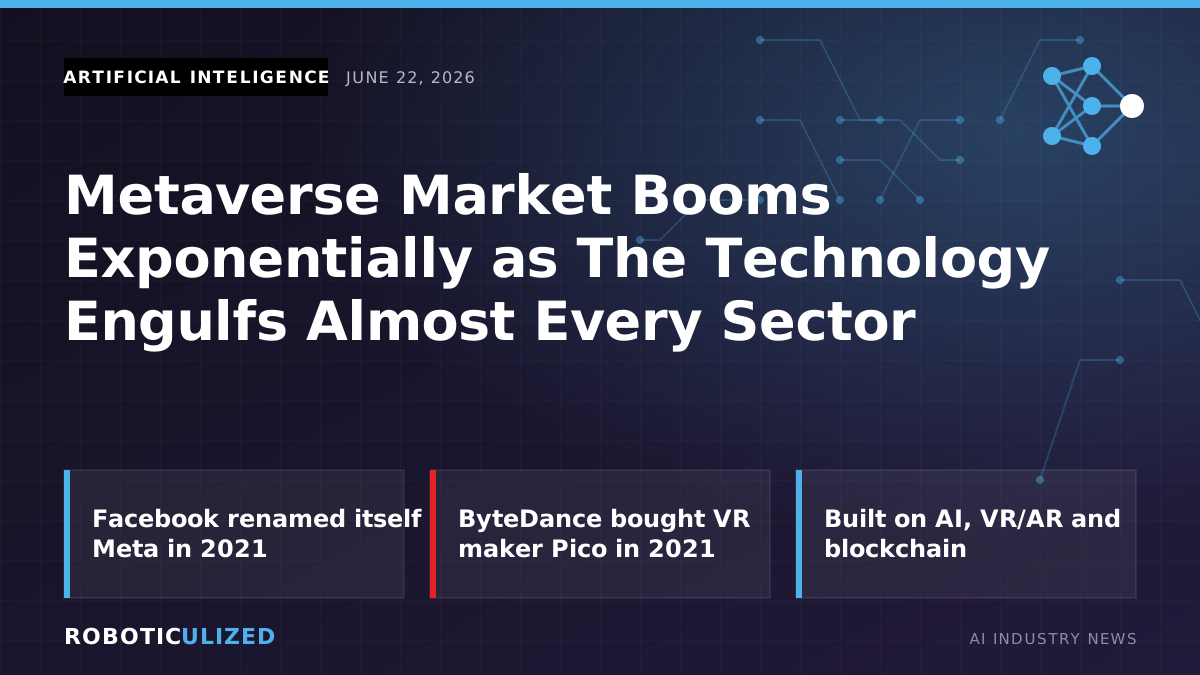
Metaverse Market Booms Exponentially as The Technology Engulfs Almost Every Sector
Analysis — June 2026 — The metaverse is often discussed as if it were a single destination, a virtual world waiting to be switched on. In practice it is better understood as a set of technologies — persistent 3D environments, avatars, immersive hardware and digital ownership — that are seeping into industries one use case at a time. Gaming got there first, but retail, education, healthcare, property, office work and finance are all experimenting, and market researchers continue to forecast very rapid growth for the sector over the rest of the decade.
The building blocks: AI, immersive hardware and blockchain
Three technology layers do most of the heavy lifting. Virtual and augmented reality, along with mixed reality that blends the two, provide the immersive front end, whether through headsets, glasses or a phone camera overlaying digital objects on the physical world. Real-time 3D engines, such as those made by Unity and Epic Games, render the spaces themselves.
Artificial intelligence is increasingly the engine of content. Building convincing virtual worlds by hand is slow and expensive; AI can help generate landscapes, buildings, characters and the routines those characters follow, and it powers the natural-language interfaces that let users talk to virtual assistants. Faster networks such as 5G are expected to supply the bandwidth and low latency needed to keep these worlds responsive.
Blockchain forms the third layer, providing a way to record who owns a digital item. Platforms such as Decentraland and The Sandbox, both built on Ethereum, let users buy parcels of virtual land and trade in-game assets as tokens. This is closely tied to the wider “Web 3.0” idea of an internet where users control and can monetise what they create, although the two concepts are distinct: the metaverse describes immersive 3D spaces, while Web 3.0 is chiefly about decentralised ownership and identity.
Gaming and entertainment lead the way
Games remain the most mature metaverse environments because they already combine persistent worlds, avatars and large online communities. Roblox lets users build and share their own experiences, and brands have followed the audience: Sony Music struck a partnership with the platform in 2021 to bring its artists into Roblox. Epic Games’ Fortnite showed the potential for live entertainment in April 2020, when a virtual Travis Scott concert drew more than 12 million concurrent players to its first showing.
Ownership-based gaming is another strand. Axie Infinity popularised the play-to-earn model, in which players receive token rewards for in-game achievements, and blockchain rewards now feature across a range of services, from an online crypto gaming platform offering on-chain rewards to virtual-land marketplaces where parcels can be resold. These models have been volatile, but they illustrate how digital economies are being layered onto play.
Beyond games: shopping, learning, health and property
The same tools are being adapted far outside entertainment:
- Retail and online shopping: augmented reality lets shoppers preview how a product looks or fits before buying, which can reduce uncertainty, while immersive storefronts give brands new ways to personalise discovery.
- Education and training: virtual environments allow job training and simulations that would be costly or risky to stage in real life.
- Healthcare: researchers count healthcare among the enterprise segments now exploring immersive and 3D tools.
- Real estate: the most literal example is the trade in virtual land itself. In 2022, metaverse technology firm TerraZero Technologies acquired a sizeable estate in Decentraland to build an entertainment venue for screenings, concerts and shopping.
- Finance: banking and financial services are listed as an enterprise segment, with crypto assets and tokens underpinning many virtual economies.
Big platforms and the enterprise push
The largest technology companies have placed visible bets. Facebook renamed itself Meta Platforms in October 2021 to signal its metaverse ambitions. Microsoft unveiled Mesh for Teams that year, bringing avatars and shared virtual spaces into workplace meetings, a sign that enterprise collaboration is a key target. Nvidia’s Omniverse platform is aimed at industrial 3D simulation and digital twins. In China, ByteDance, the owner of TikTok, acquired VR headset maker Pico in 2021, while Tencent and NetEase are among the other key vendors that analysts track in the sector. Hardware makers are moving too: HTC announced its Viverse platform in 2022, combining VR, AR, blockchain and AI.
Why it matters
The spread of metaverse technology across sectors is less about one company’s virtual world than about converging capabilities: AI that makes 3D content cheap to produce, devices that make it immersive and ledgers that make digital goods ownable. That convergence explains why such different industries are interested at once. Yet adoption has been uneven, consumer headsets remain a niche, and crypto-linked economies have proved volatile. For the AI industry in particular, generative tools may turn out to be the deciding factor, since the cost of creating virtual content has long been one of the biggest barriers to building worlds people actually want to visit.