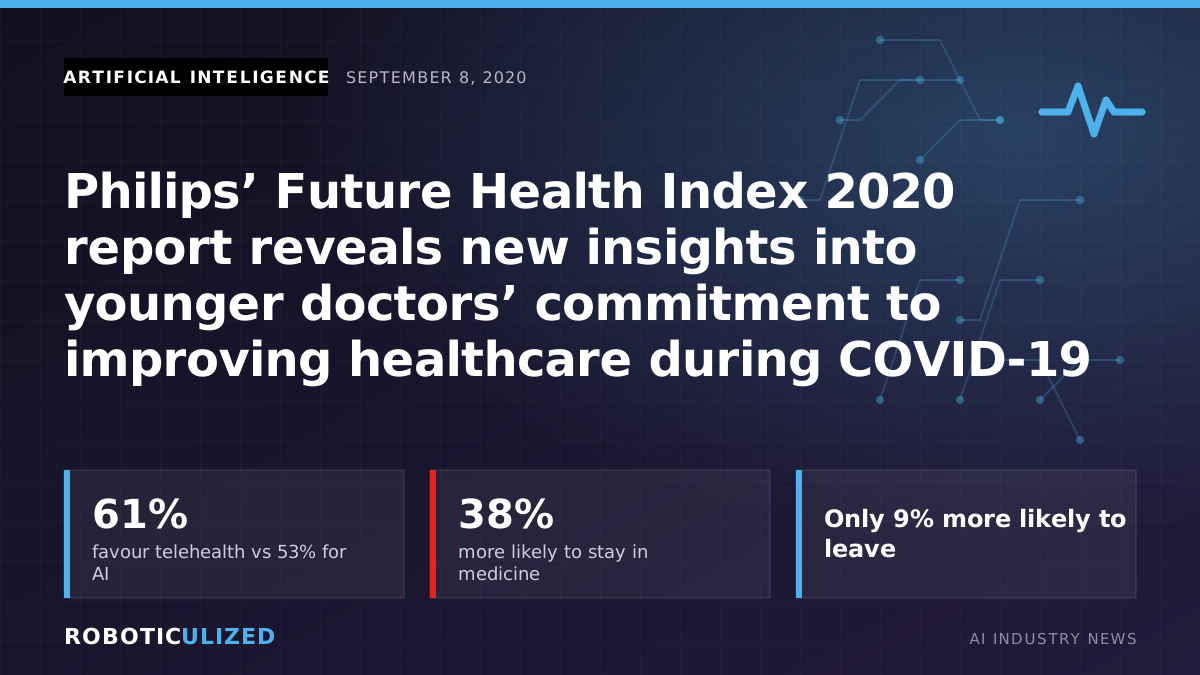
Philips’ Future Health Index 2020 report reveals new insights into younger doctors’ commitment to improving healthcare during COVID-19
Amsterdam — September 8, 2020 — The COVID-19 pandemic has reshaped how younger doctors think about digital health, with telehealth now edging out artificial intelligence as the technology they believe would have made the biggest difference to their working lives during the crisis. That is one of the main findings of new research from Royal Philips, released as an add-on to its Future Health Index (FHI) 2020 report.
The study, titled Future Health Index Insights: COVID-19 and Younger Healthcare Professionals, polled 500 doctors aged under 40 across five countries: the United States, China, Singapore, France and Germany. It set out to understand how the pandemic has affected the attitudes and day-to-day experiences of the next generation of physicians, and what they think should change in healthcare as a result.
Telehealth moves ahead of AI
Asked which digital health technology would have most improved their experience during the pandemic, 61% of the young doctors named telehealth, while 53% chose AI. That marks a notable reordering. In the main FHI 2020 research, carried out before the pandemic, AI led the way: 60% of younger healthcare professionals picked it as the technology most likely to boost their job satisfaction, compared with 39% for telehealth. The two questions were framed differently, but together they suggest the crisis pushed doctors toward tools that offered immediate, practical help with seeing patients remotely.
Respondents also saw room for the technology to work better in practice. When asked what would have helped them make better use of the health data available at the peak of the outbreak, 47% pointed to stronger data integration — both between hospitals and practices, and between different IT systems and electronic medical records.
An appetite for more digital tools
For many respondents, the pandemic offered a preview of a more technology-driven workplace. Some 44% said the crisis introduced them to new ways of using digital health technologies, and many want those changes to stick once the emergency passes. When asked which pandemic-era shifts they most hoped would last, the top answers were closely bunched:
- Exposure to new types of digital health technology (29%)
- New ways of using digital health technology (29%)
- Greater appreciation from patients (29%)
- Faster availability of digital health technology (28%)
Strain, but not an exodus
The findings arrive against a backdrop of concern that the pandemic is piling extra pressure and ethical dilemmas onto clinicians, worsening already high rates of burnout and related mental health problems. Yet the survey points to resilience rather than flight among younger doctors. More than a third (38%) said their experience of working through COVID-19 had made them more likely to remain in medicine. A majority (53%) said it had not changed their intentions either way, and only 9% said they were now more likely to leave.
Some of the reasons may lie in how their working days changed. Nearly half (47%) reported receiving more appreciation from patients, while 44% said they had collaborated more with colleagues from different disciplines. Doctors in China stood out, with 70% saying they had felt a stronger sense of purpose at work since the outbreak began.
Jan Kimpen, Chief Medical Officer at Royal Philips, said the results show younger doctors remain “as committed as ever to their vocation,” despite the stress and resource shortages many have faced. He argued that the views of frontline staff should inform decisions about how healthcare is organised and delivered in future.
The survey was conducted between June 19 and July 30, 2020, with 100 respondents per country, all of whom had completed their first medical degree. It was run online and offline depending on local needs, in each country’s native language, and took about ten minutes to complete. Philips has run its Future Health Index research since 2016 to assess how prepared countries are to meet global health challenges.
Why it matters
The shift from AI to telehealth is a useful reminder that clinicians judge technology by what it does for them today. AI promises long-term gains in diagnosis and workflow, but during a crisis that kept patients away from clinics, video and remote consultation tools delivered value immediately. For AI developers targeting healthcare, the findings underline that adoption will depend on fitting into real workflows — and the strong call for better data integration suggests interoperability remains a bottleneck for both telehealth and AI alike.
The sample is modest, at 100 doctors in each of five countries, and the survey is commissioned by a company that sells health technology, so the results are best read as an indicator of sentiment rather than a definitive measure. Still, the picture of a younger workforce that is both open to digital tools and largely staying put is relevant to health systems planning their post-pandemic investments.