Metaverse Market Booms Exponentially as The Technology Engulfs Almost Every Sector – Report by Market Research Future (MRFR)
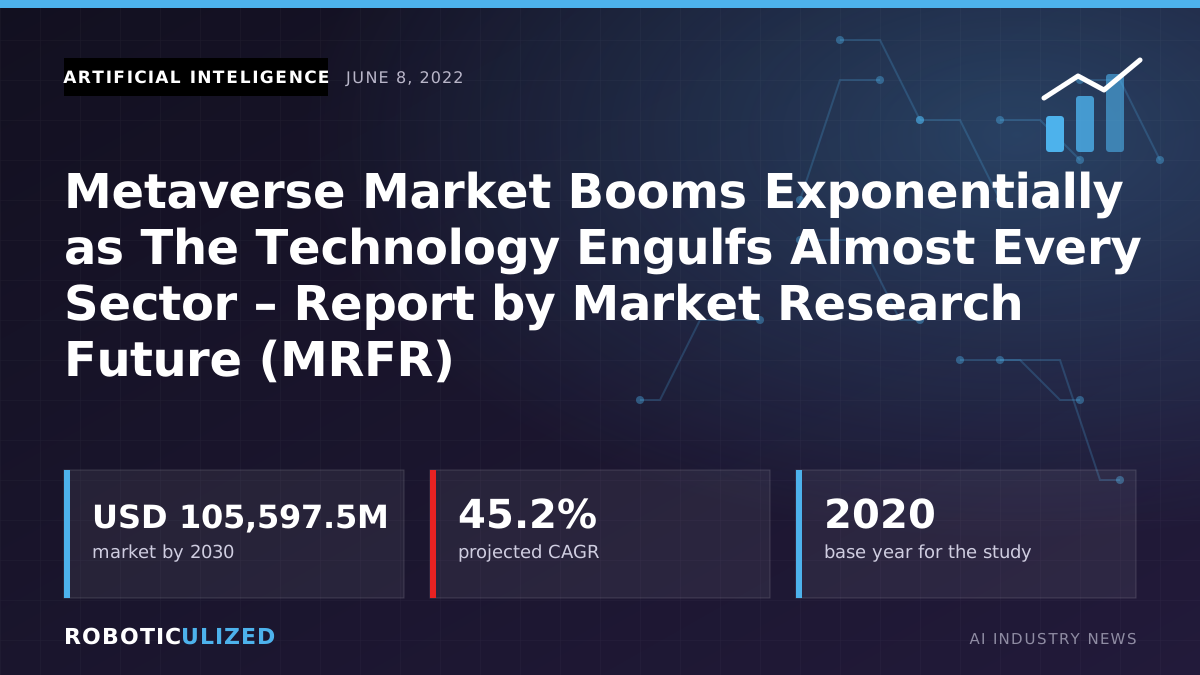
New York — June 8, 2022 — Market Research Future (MRFR) released a new study on the metaverse, projecting that the global market for shared virtual worlds and the technology behind them would reach USD 105,597.5 million by 2030. The research firm forecast a compound annual growth rate of 45.2 percent over the forecast window, using 2020 as its base year. MRFR said the concept was spreading into nearly every major sector, from consumer entertainment to banking, healthcare and engineering.
The report arrived at the height of corporate interest in the metaverse. Large technology companies had spent the previous year rebranding, reorganizing and committing capital to immersive platforms. MRFR set out to measure how that interest might turn into spending on hardware, software and services by the end of the decade.
How MRFR divided the market
The study split the metaverse along several axes so that different parts of the industry could be tracked separately. By component, it covered hardware and software. By platform, it looked at desktops and laptops, mobile devices and wearables, the last of which includes headsets and other body-worn gear.
On the technology side, MRFR grouped the market into blockchain, virtual and augmented reality, mixed reality and other enabling technologies. The application breakdown covered gaming, online shopping, content creation and social media. End users fell into two broad camps: individual consumers and enterprises.
- Component: hardware and software
- Platform: desktops and laptops, mobiles, wearables
- Technology: blockchain, VR and AR, mixed reality
- Application: gaming, online shopping, content creation, social media
- End user: consumers and enterprises
The enterprise segment drew particular attention in the report. MRFR listed banking, financial services and insurance (BFSI), retail, media and entertainment, education, real estate, aerospace and defense, healthcare and engineering as industries where it expected organizations to adopt immersive tools. The breadth of that list supported the firm’s main claim that the metaverse was no longer just a gaming story.
What MRFR said was driving growth
MRFR named several forces behind its forecast. The first was a broad push to merge digital and physical experiences over the internet. The firm also pointed to the growing traction of mixed reality and to the popularity of non-fungible tokens, 3D avatars, immersive gaming and cryptocurrencies, all of which encourage people to spend time and money in virtual spaces.
Spending by big technology companies was another driver. The report cited investment from Microsoft, Facebook, Google and Zoom. It also said supporting technologies would speed up adoption, singling out 5G networks, artificial intelligence and extended reality. Among the trends MRFR highlighted was the use of AI to generate metaverse content, alongside blockchain-based ownership systems and networked VR headsets.
The release also listed recent industry moves as evidence of momentum. HTC was reported to be developing a metaverse-oriented smartphone under its Viverse banner. TerraZero Technologies had bought virtual land in Decentraland to build an entertainment venue.
Regions and leading companies
The study’s geographic coverage spanned North America (the United States, Canada and Mexico), Europe (including the UK, Germany and France), Asia-Pacific (including China, Japan and India), the Middle East and Africa, and South America. MRFR noted that businesses across North America were already making heavy use of 3D simulation, augmented reality and virtual reality.
The competitive landscape section profiled major platform owners and content companies. MRFR named Meta Platforms, Nvidia, Microsoft, Tencent and ByteDance among the key vendors. It also listed Epic Games, NetEase, Roblox, Lilith Games, Nextech AR Solutions and Unity Software. The mix of chipmakers, social media giants, game studios and engine developers showed how many layers of the technology stack the firm counted as part of the metaverse.
Why it matters
Market sizing reports like this one are best read as signs of sentiment rather than precise predictions. Metaverse forecasts published in 2022 varied enormously from one research house to the next, depending on how each firm defined the market. MRFR’s figure of roughly USD 105.6 billion by 2030 sat at the more modest end of that range. Its 45.2 percent growth rate still assumed very rapid expansion from a small base.
For the AI industry, the report’s link between immersive platforms and machine learning was the most relevant detail. Generating 3D environments, animating avatars, moderating virtual spaces and powering lifelike digital characters all depend heavily on AI models and GPU compute. That helps explain why a chip company like Nvidia appeared beside social and gaming platforms on MRFR’s vendor list. Whether enterprise adoption across sectors such as healthcare, education and engineering would match the report’s expectations remained an open question. Even so, the study captured how strongly investors and vendors expected AI and immersive computing to grow together over the rest of the decade.