Is It Possible to Use AI to Beat Online Casino Games?
Analysis — November 2026 — Artificial intelligence now writes code, reads medical scans and beats world champions at board games, so a question keeps coming up in forums, comment sections and ads: can AI beat an online casino? A growing number of apps, bots and “prediction” services claim it can. The short answer is no. To see why, it helps to look at how casino games are built, where AI really has beaten human players, and why those wins don’t carry over to the games most people play online.
The house edge is built into the maths
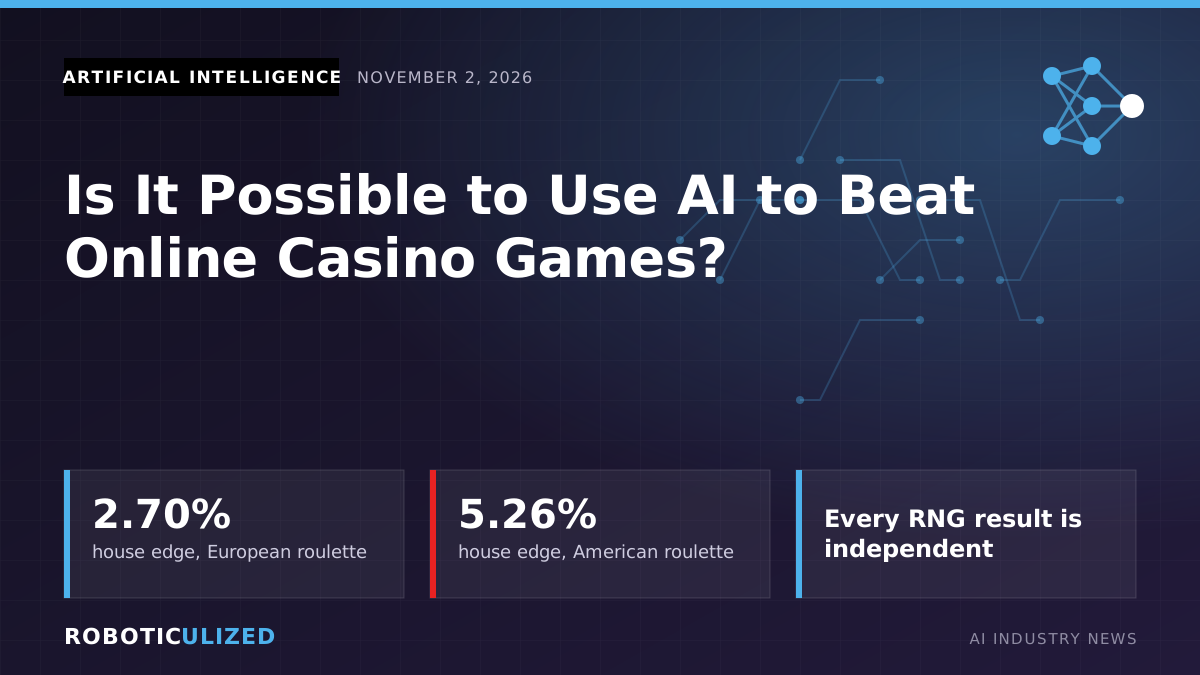
Every casino game is designed so that, over many rounds, the operator keeps a share of everything wagered. This is the house edge, and it comes from the rules of the game, not from any pattern a computer could find. In European roulette there are 37 pockets, but a winning single-number bet pays 35 to 1, as if there were only 36. That gap gives the house an edge of about 2.70% on every spin. American roulette adds a double zero, which raises the edge to about 5.26%.
Slot machines work the same way, expressed as return to player (RTP). A slot with a 96% RTP is designed to pay back about 96 cents of every euro wagered over the long run, so the house keeps about 4%. Crash, Plinko and Mines-style games publish a built-in edge too. No model, however advanced, can change the payout table. The best an AI system can do is calculate the edge more precisely than a human could, and the answer is still negative.
Random number generators leave nothing to predict
Machine learning is good at finding patterns in data. Online casino games are built to have none. Each spin, card or crash point comes from a random number generator (RNG), and licensed operators have these generators tested by independent labs such as eCOGRA, GLI and iTech Labs. Each result is independent of the one before. A run of ten reds tells you nothing about the eleventh spin.
This is why “AI predictors” for roulette, slots or crash games don’t work. Train a model on thousands of past results and it will either find nothing, or find patterns that are really just noise and disappear on new data. Believing that past results influence future ones is the gambler’s fallacy, and putting it inside software doesn’t fix it. Betting systems such as the Martingale, where you double your stake after each loss, fail for the same reason: they change how losses are spread out, not the edge behind them, and table limits and a finite bankroll eventually end the streak.
Where AI really has beaten humans
The famous AI successes in gaming came in games of skill, not games of chance. In poker, Carnegie Mellon’s Libratus beat leading professionals at heads-up no-limit hold’em in 2017. Pluribus, developed with Facebook AI, did the same in six-player games in 2019. Poker can be beaten because players compete against each other, and the house takes only a fee. These systems won by outplaying humans, not by predicting cards.
Using that kind of software against people for real money is a different matter. Real-money poker sites ban bots and real-time assistance tools, run detection systems to catch them, and close accounts that use them, often keeping the balance. Blackjack is the other game where skill matters. Basic strategy can cut the house edge to roughly half a percent under good rules, but that still leaves a small edge for the house. Card counting, the one route to an advantage, depends on tracking a shoe across hands. Most online blackjack reshuffles virtually after every hand, so there is nothing to count.
Be wary of anyone selling an AI edge
If a tool really could beat a casino, its creators would have no reason to sell it for a monthly fee on social media or in messaging apps. Most “AI casino bots” and “signal” groups make their money from subscriptions, affiliate commissions on deposits, or by collecting payment details, not from winning. Warning signs include promises of guaranteed profits, screenshots of big wins, pressure to deposit at a particular casino, and claims to have “hacked” an RNG. Even a legitimate automation tool would usually break a casino’s terms, putting the account and any winnings at risk.
Why it matters
AI is changing how people work and make decisions, and that makes “AI-powered” an easy label to stick on old schemes. Casino games are designed so the house wins over time. Machine learning can’t remove an edge that is written into the payout rules, and it can’t predict outcomes that are random by design. Using AI to try to beat online casinos is therefore not something we recommend. It costs money, and it often means handing that money to people selling a fantasy.
If you’re curious about how these games behave, or want to test a strategy or an AI idea for yourself, do it where nothing is at stake. We only recommend trying ideas like these on free online gambling games, where play uses free coins with no cash value and nothing can be lost. You’ll see the house edge at work for yourself without paying for the lesson. Anyone who does choose to gamble for real money should be of legal age, set a firm budget in advance, treat it as entertainment rather than income, and seek support if it stops being fun.