IIIT Hyderabad’s Annual R&D Showcase On 6 March
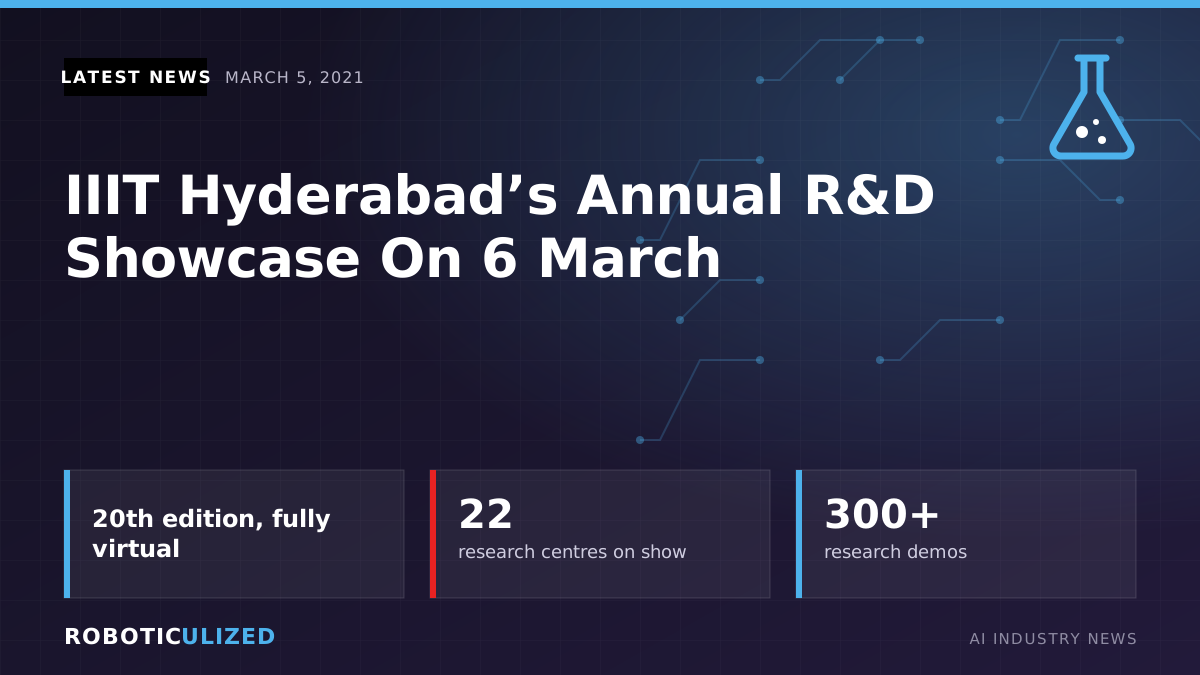
Hyderabad — March 5, 2021 — The International Institute of Information Technology, Hyderabad (IIIT-H) announced that its annual research and development showcase would take place on Saturday, 6 March 2021, entirely online. It was the 20th edition of the event, which has become one of the institute’s main ways of presenting its research to the outside world. Because of continuing pandemic restrictions, it was a departure from the in-person format visitors were used to.
In past years the showcase usually brought more than 3,000 visitors to the campus. They came from research labs, universities, the media and industry to see what the institute’s students and faculty had been building. The 2021 edition moved that experience onto a web portal, so the research could be explored remotely.
A large research footprint, online
The event covered the work of all 22 of IIIT-H’s research centres and included more than 300 research demonstrations. That scale reflected the institute’s reputation as one of India’s more research-intensive technology schools.
The programme opened with an inaugural keynote by Professor Ashok Jhunjhunwala, an Institute Professor at IIT Madras. His talk set the tone for a day devoted to research with real-world impact.
AI and smart city research in focus
Among the work on display, the institute highlighted three centres in particular:
- Kohli Centre of Intelligent Systems (KCIS): the institute’s hub for research on intelligent systems and artificial intelligence.
- Smart City Research Centre: a recently launched centre set up together with the Ministry of Electronics and Information Technology (MeitY), the national Smart City Mission and the Government of Telangana.
- Applied AI Research Centre (INAI): a centre working with Intel and the Government of Telangana to apply artificial intelligence to population-scale problems in India.
INAI’s mandate was especially notable. Rather than chasing benchmark results alone, the centre aims to use AI on problems that affect very large numbers of people in India. Its partnership model, which links a global chipmaker, a state government and an academic institution, was an example of the collaborative structures that had been forming around applied AI in the country.
The Smart City Research Centre similarly connected academic research with public-sector priorities. Its government partners at both the national and state level showed the policy interest in data-driven urban management.
Adapting to a virtual audience
Director Professor P J Narayanan acknowledged that the institute would miss the face-to-face conversations the showcase usually encouraged with visitors from other institutions and from industry. He added, however, that students had embraced the virtual format with enthusiasm. In his view, the online setting gave them the chance to present their work to a much wider audience without geographic limits.
That point captured one of the unexpected benefits of the pandemic-era shift to online events. A showcase that once depended on people travelling to Hyderabad could now be visited by researchers, recruiters and partners anywhere. This was especially useful for an institute that wanted its work to reach industry collaborators and academic peers outside the region.
Why it matters
University research showcases rarely make global headlines, but they offer a useful view of where a country’s AI talent and applied research are heading. IIIT-H’s 2021 event underlined two trends in India’s AI ecosystem. The first was the growing role of joint centres that bring together academia, government and multinational technology firms, as seen in INAI and the Smart City Research Centre. The second was a clear focus on applying AI to large-scale national needs rather than treating it as a purely academic field.
The decision to go fully virtual for the 20th edition also reflected how research institutions were adapting during the pandemic. With hundreds of demos available online, the showcase lowered the barrier for companies and other universities looking for research partners or future hires. For an AI industry that increasingly looks to India for engineering talent and real-world deployment opportunities, events like this one show the pipeline that is forming in the country’s research institutes.