Biopesticides Market Worth $8.5 Billion by 2025 – Exclusive Report by MarketsandMarkets™
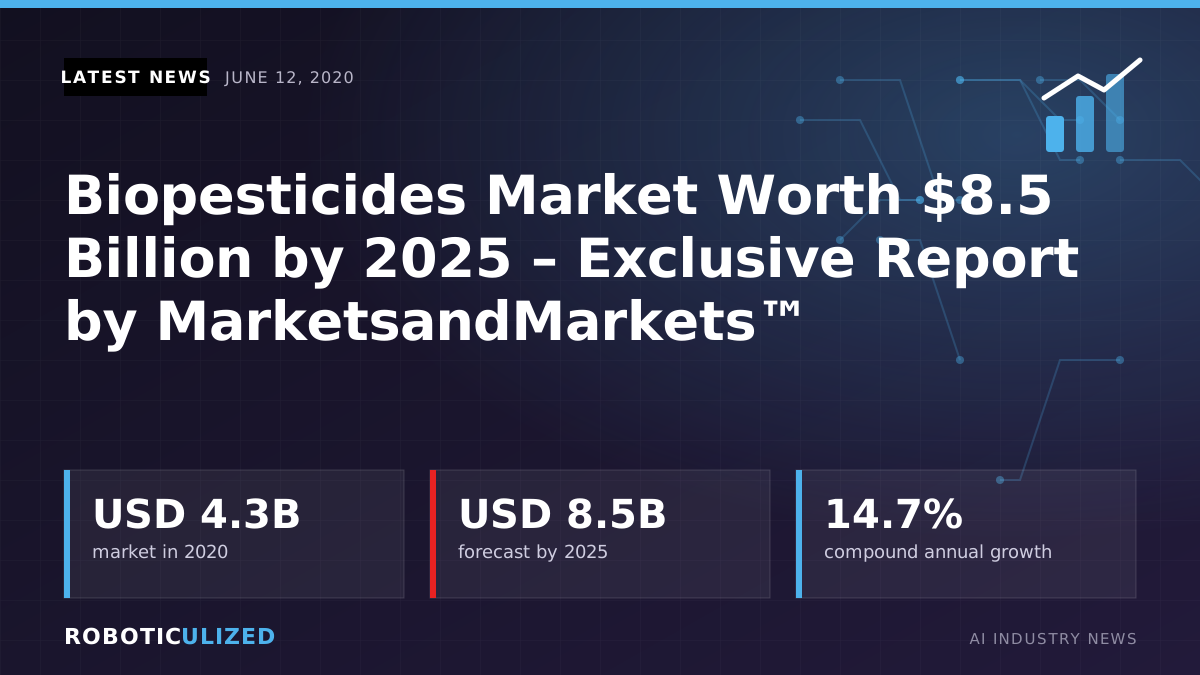
Chicago — June 12, 2020 — The global market for biopesticides is on track to almost double in five years, according to a new forecast from research firm MarketsandMarkets. The report puts the market at USD 4.3 billion in 2020 and projects it will reach USD 8.5 billion by 2025. That is a compound annual growth rate of 14.7%, as growers look for alternatives to conventional chemical crop protection.
Scope of the study
The report is titled “Biopesticides Market by Type (Bioinsecticides, Biofungicides, Bionematicides, Bioherbicides), Source (Microbials, Biochemicals, Beneficial Insects), Mode of Application, Formulation, Crop Application, Region – Global Forecast to 2025.” It runs to 249 pages, with 118 tables and 52 figures. It splits the market by the type of pest each product targets, by whether the active agent is a microorganism, a naturally derived compound or a beneficial insect, and by how and where the products are used.
Biopesticides are pest-control products made from natural materials rather than synthetic chemistry. They include bacteria, fungi and viruses that attack specific pests, plant extracts and other naturally occurring substances, and insects that prey on crop pests. They usually target a narrower range of organisms than conventional pesticides and break down faster in the environment. This has made them more attractive as regulators and food retailers push for fewer chemical residues in the food supply.
What is driving demand
The analysts name several forces behind the market’s growth:
- A growing area of farmland under organic cultivation.
- Rising concern about the health and environmental hazards of synthetic pesticides.
- Demand for high-value crops that are free of chemical residues.
- The gradual phase-out of several key chemical active ingredients.
- Government policies that support biological alternatives.
The report also notes the desert locust outbreaks that have recently damaged important crops. It says these attacks show the need for sustainable ways to control invasive pests, and that biological products could fill that role.
Fruits, vegetables and greenhouses lead the way
Fruits and vegetables stand out among crop types. MarketsandMarkets says they are the largest segment and the fastest-growing one. Growth there is tied to the spread of protected cultivation such as greenhouses, consumer demand for residue-free produce, and the return of pests that affect these crops. Among application methods, foliar spray is expected to grow strongly, helped by its ease of use, safety and the lack of risk of chemical burn to plants.
By region, the report expects Europe’s potential to grow over the forecast period. It cites strict limits on chemical residues, increasing pest resistance to conventional products, demand for organic food, tight rules on chemical use and the needs of export-quality produce.
The report lists formulation as its own dimension, covering the different forms in which products are sold, along with source categories. Microbial products are built around living organisms, biochemicals around naturally derived substances, and beneficial insects are released to keep pest populations down. Each category raises its own challenges for production, shelf life and use in the field, which helps explain why the market includes both large multinationals and focused specialists.
The study profiles a mix of agrochemical majors and biological specialists. These include BASF, Bayer, Syngenta, FMC, UPL, Nufarm, Novozymes, Marrone Bio Innovations, Certis USA, Valent Biosciences, Koppert Biological Systems, Biobest Group, BioWorks, Andermatt Biocontrol, Isagro, STK Bio-ag, Vegalab, Bionema, Som Phytopharma India and International Panaacea.
Why it matters
Biopesticides are a field where agricultural biology and data science are coming together. Finding effective microbial strains and natural compounds increasingly depends on genomic screening and machine learning to search large biological libraries faster than traditional lab work. Biologicals also tend to work best when applied precisely and at the right moment. That makes them a natural fit for AI-driven crop monitoring, pest prediction models and variable-rate spraying.
If the market nearly doubles as forecast, demand for these digital agriculture tools is likely to grow with it. That would create opportunities for agtech companies building computer vision, disease forecasting and farm analytics platforms. The locust outbreaks noted in the report also highlight how early-warning systems and sustainable treatments are increasingly being discussed together as parts of the same food-security strategy.