Diagnos A.I. retinal screening technology expands into international markets
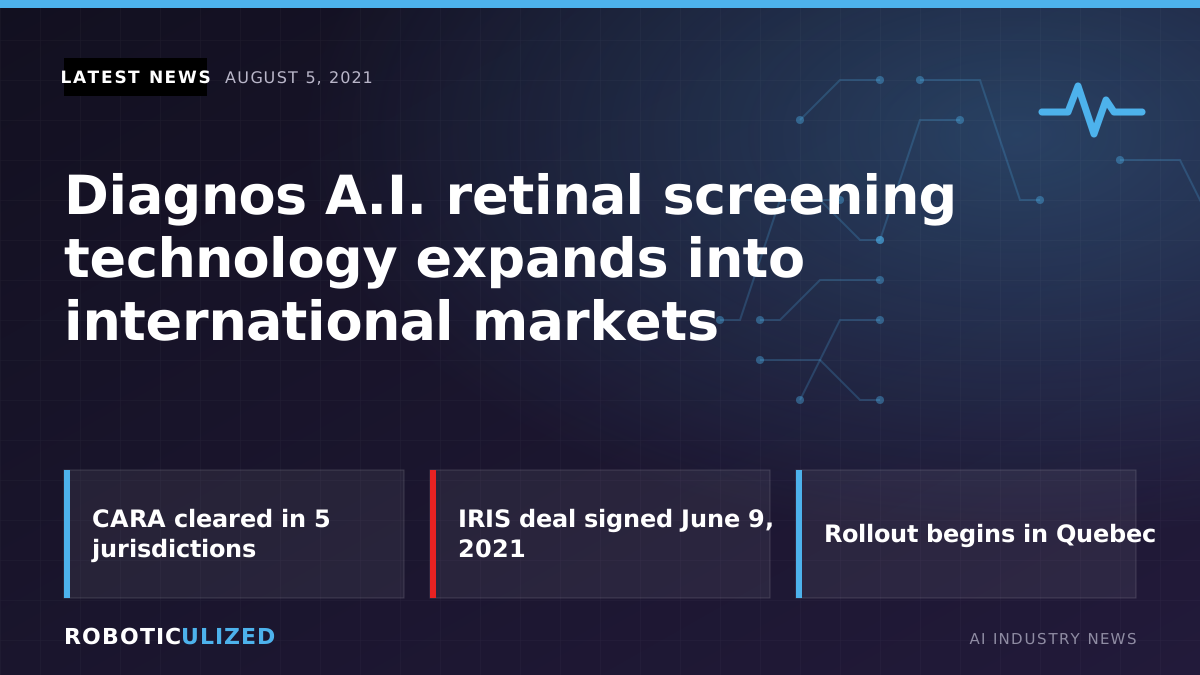
Vancouver — August 5, 2021 — Diagnos (TSXV: ADK, OTCQB: DGNOF, FRA: 4D4A), a Canadian company focused on the early detection of health problems with artificial intelligence, is expanding its retinal screening technology into more international markets. The company is opening clinics and signing distribution partnerships in Canada, Spain, Saudi Arabia, Mexico, Costa Rica, the United States and other parts of Europe, and says it may move into further territories.
FLAIRE and CARA
Diagnos’s products are built on FLAIRE, its in-house AI platform. FLAIRE powers CARA, short for Computer Assisted Retina Analysis. CARA uses AI image-enhancement algorithms to produce sharper retinal photographs, which can then be checked for signs of disease or other abnormalities.
The retina is one of the few places where blood vessels can be seen directly without an invasive procedure. Diagnos argues that this makes retinal images useful beyond eye care. Besides conditions such as diabetic eye disease, the company says its technology can help flag patients who may be at higher risk of heart attack or stroke.
The company’s work in retinal screening has also brought it into academic medicine. Earlier this year Diagnos announced a three-year partnership with the Centre Hospitalier de l’Université de Montréal (CHUM) to develop AI for the early detection of retinal diseases. Diagnos has said it aims to be cash-flow positive by the end of 2021. It also points to the large number of optometrists around the world as a ready network for capturing the images its software analyzes.
Regulatory clearances in place
A large part of Diagnos’s expansion plan rests on the approvals CARA has already received. The system has been cleared by:
- Health Canada
- The U.S. Food and Drug Administration
- Mexico’s COFEPRIS
- European regulators under the CE/EC framework
- The Saudi Food and Drug Authority
With clearance in several major jurisdictions, the company can approach clinics and distributors in different regions without having to wait for separate approvals in each one first.
Optometry partnership starts in Quebec
Diagnos’s biggest recent commercial step came on June 9, 2021, when it signed a multi-year agreement with IRIS The Visual Group. Under the deal, AI-based retinal vascular screening will be offered in IRIS optometry clinics, starting in Quebec under the provincial government’s INVEST-AI program. IRIS is part of New Look Vision Group, which runs several hundred eyewear locations across North America. The deal anticipates a wider rollout depending on results in Quebec.
The strategy relies on optometrists, who already take retinal photographs as part of routine exams. If images from these everyday visits are sent through AI analysis, screening could reach many people who might never see a specialist. Diagnos points to diabetes as a key target. The company’s vice president of sales has noted that it is the leading cause of vision loss worldwide, and many people with the condition do not know they have it.
The scale of the problem explains why. The International Diabetes Federation estimated that 463 million people worldwide had diabetes in 2019. It projects that number will rise to 578 million by 2030 and 700 million by 2045, and about half of those affected are undiagnosed. Regular retinal checks are recommended for people with diabetes, but the number of specialists available to read the images has not kept up.
Why it matters
AI has been adopted in medicine more slowly than many forecasts predicted. Healthcare providers have been careful about relying on algorithms for clinical decisions, and the patchwork of national regulations makes expansion across borders hard. Diagnos’s announcement shows one way past both problems: secure approvals in several jurisdictions first, then distribute through existing clinical networks rather than asking providers to change how they work.
Retinal imaging has become one of the most active areas for medical AI because it produces standardized, high-volume images and serves a clear screening need. Smaller companies like Diagnos are competing in this space alongside larger technology firms. Whether the Quebec rollout produces strong clinical and commercial results will be closely watched as a sign of whether AI screening can move from pilot programs into everyday primary eye care.