OrigiMed announced its strategic partnership with Janssen to develop clinical innovative solutions driven by data science
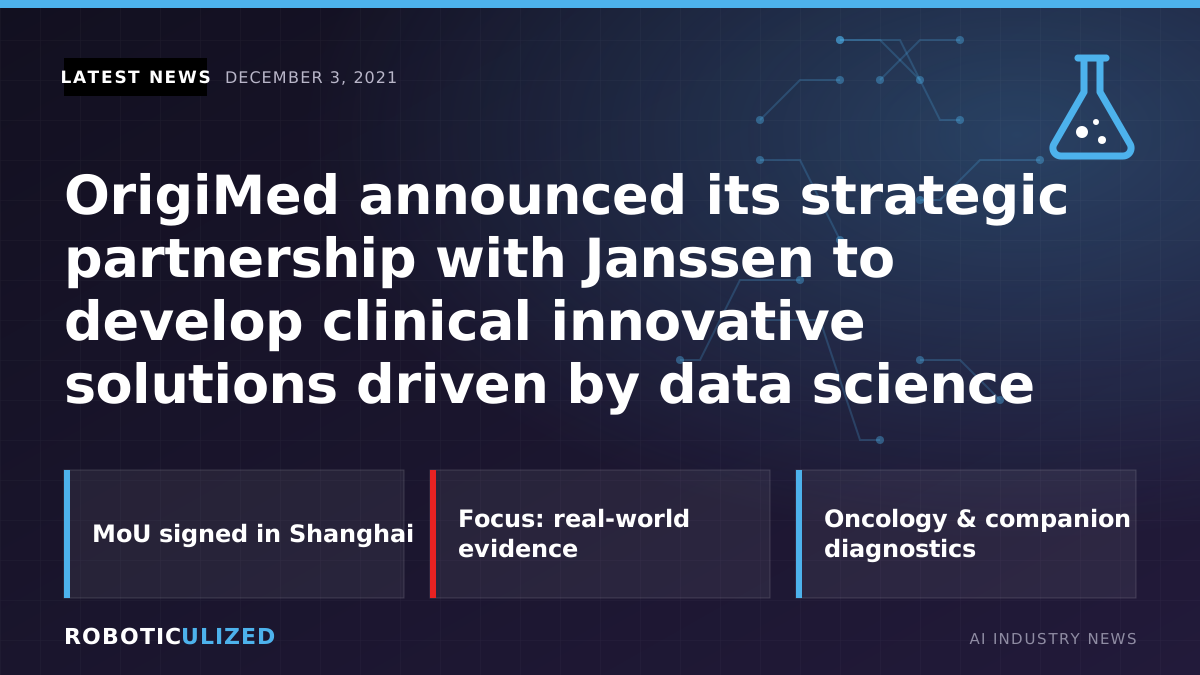
Shanghai — December 3, 2021 — Chinese precision oncology company OrigiMed Co., Ltd. has signed a memorandum of understanding on strategic collaboration with the Janssen (China) Research and Development Center of Johnson & Johnson (China) Investment Co., Ltd. The two organizations plan to use data science and real-world evidence to reshape how cancer clinical trials are designed and run in China, and to speed the development of companion diagnostics and anti-tumor medicines.
The agreement brings together OrigiMed’s genomic and clinical data assets with the drug development experience and data science capabilities of Janssen, the pharmaceutical arm of Johnson & Johnson.
A high-level signing
The MoU was signed by Yi Zheng, Head of the Asia Pacific Center of Excellence in Translational Science at Janssen R&D, and Dr. Kai Wang, Chief Executive Officer of OrigiMed. Also attending the ceremony were Zili Li, Head of Asia Pacific R&D at Janssen R&D; Jenny Zheng, President of Janssen China; and Ping Zhao, OrigiMed’s Senior Vice President of pharmaceutical cooperation.
Two senior Janssen executives based outside China joined by video: Najat Khan, Chief Data Science Officer at Janssen R&D, and Zach Boyd, Head of Oncology Diagnostics. Khan pointed to China as a promising setting for real-world evidence studies, noting that Janssen sees “great potential in China” for designing and carrying them out.
Real-world evidence at the core
At the heart of the partnership is real-world evidence: insights drawn from data generated in routine clinical care rather than in controlled trials. The companies intend to use this evidence to refine clinical trial designs and to improve patient enrollment, a long-standing challenge in oncology research where eligible patients can be difficult to identify.
The collaboration’s stated focus areas include:
- Building a real-world evidence database based on OrigiMed’s real-world data.
- Medical imaging analysis.
- Optimizing clinical trials and patient recruitment using real-world evidence.
- Developing innovative clinical solutions and accelerating the development and commercialization of companion diagnostics and anti-tumor drugs.
- Offering patients more comprehensive health management solutions.
The partners also said they would explore developing and registering diagnostics and companion diagnostics with support from Greater Bay Area policies, with the aim of giving patients earlier access to new tests.
What each side brings
OrigiMed specializes in anti-tumor precision medicine and has built its business around next-generation sequencing. Under the agreement, it will contribute its sequencing technology, gene database, patient follow-up database and real-world study capabilities. The company also plans to build a digital service platform and help refine market strategies for new anti-tumor drugs and companion diagnostic products.
Janssen, for its part, has made data science a strategic priority across its research organization. The company has been applying AI and advanced analytics to both structured and unstructured data to build a more complete picture of patients in real-world settings, deepen understanding of existing therapies and support data-driven decisions throughout the drug development lifecycle.
The pairing is complementary. Sequencing-based diagnostics companies hold detailed molecular profiles of patients, but those records become far more useful to drug developers when linked to treatment histories and outcomes over time. Pharmaceutical companies, meanwhile, need that combined view to decide which patient groups to target, where to run trials and which biomarkers should accompany a new therapy. The memorandum sets out a framework for the two sides to pursue those goals together.
Why it matters
The deal illustrates how large pharmaceutical companies are increasingly looking to local data partners to power AI and analytics work in major markets. China has a vast oncology patient population, and genomic and follow-up data collected by companies such as OrigiMed can help sponsors identify suitable trial candidates, design more efficient studies and understand how therapies perform outside controlled conditions.
Regulators worldwide, including in China, have shown growing interest in the use of real-world data to support clinical development and regulatory decisions. Partnerships that combine sequencing data, clinical follow-up and imaging analysis could help shorten development timelines for targeted cancer drugs and the companion diagnostics that determine which patients receive them. As with any data-intensive health initiative, data quality, standardization and privacy safeguards will play a large role in determining how much value the collaboration ultimately delivers.