Altos Labs launches with the goal to transform medicine through cellular rejuvenation programming
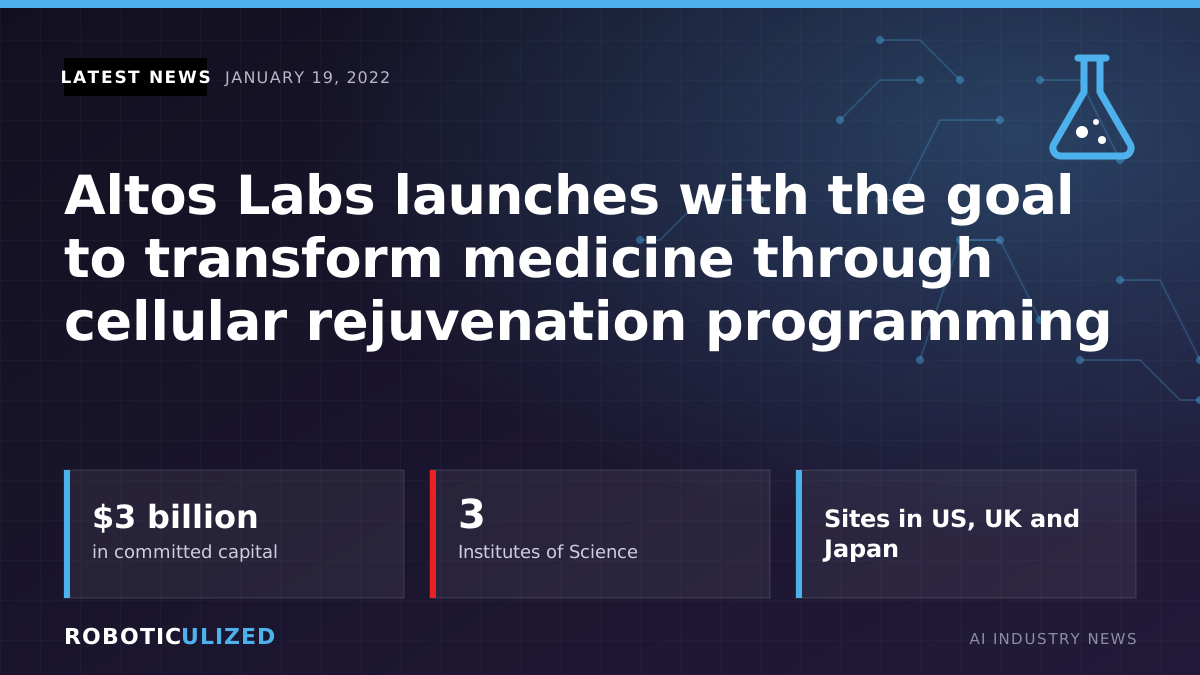
San Francisco — January 19, 2022 — Altos Labs publicly launched as a new biotechnology company focused on cellular rejuvenation programming. Its goal is to restore health and resilience to cells, with the aim of reversing disease, injury and disability. The company said it had $3 billion in committed capital from company builders and investors. It also named a leadership team drawn from some of the most prominent organizations in drug development and biomedical research.
The core idea behind Altos is that the processes cells use to stay healthy, and to recover from stress, can be understood and then deliberately reactivated. Its research builds on discoveries showing that mature cells can be pushed back toward a younger state. The company plans to turn that science into new medicines.
A leadership team from pharma and science
Altos announced that Hal Barron, MD, would become chief executive officer and co-chair of its board, effective August 1, 2022. At the time of the announcement, Barron was President of Research and Development and Chief Scientific Officer at GSK. He was joining alongside the company’s two founders:
- Rick Klausner, MD, Chief Scientist and Founder, a former director of the US National Cancer Institute.
- Hans Bishop, President and Founder, previously chief executive of GRAIL and of Juno Therapeutics.
- Ann Lee-Karlon, PhD, Chief Operating Officer, a former senior vice president at Genentech.
Klausner described the scientific mission in plain terms, saying “Altos seeks to decipher the pathways of cellular rejuvenation programming.” Klausner, Bishop and Barron would co-chair the board, whose other members included Frances Arnold, Jennifer Doudna, Maria Leptin, Robert Nelsen and Rajiv Shah, with David Baltimore serving as lead independent director.
Institutes of Science and an Institute of Medicine
Altos chose an unusual organizational design that looks more like a research university than a typical startup. Its work is split between three Institutes of Science and a separate Institute of Medicine. Each science institute had a well-known research leader:
- San Francisco Bay Area: led by Peter Walter, PhD.
- San Diego: led by Juan Carlos Izpisua Belmonte, PhD.
- Cambridge, UK: led by Wolf Reik, MD.
The Institute of Medicine was designed to translate discoveries about cell health into potential treatments. The company also said it would have significant collaborations in Japan. Shinya Yamanaka, MD, PhD, whose Nobel Prize-winning work showed that adult cells could be reprogrammed into stem cells, joined as an unpaid senior scientific advisor and would oversee the research there.
Board members presented the structure as a deliberate break from conventional biotech. Frances Arnold called it an entirely new model for research and development. Maria Leptin said she welcomed its broad, curiosity-driven approach. The design pairs basic research in the three science institutes with the Institute of Medicine’s job of turning promising findings into therapies.
Computation at the core
Altos also signaled that machine learning would be central to its approach. It named Thore Graepel, PhD, as global head of computational science, artificial intelligence and machine learning. His appointment suggested Altos planned to rely on large-scale data analysis and modeling to map the complex molecular pathways that control how cells age and recover.
Why it matters
The size of Altos Labs’ launch made it a landmark for the emerging field of longevity and rejuvenation science. Three billion dollars in committed capital gave the company the freedom to pursue fundamental research for years before needing a product. That is rare in biotech, where startups usually race toward clinical milestones. Its recruitment of a sitting big-pharma R&D chief, a former NCI director and a board of renowned scientists added scientific credibility to a field that has often struggled against skepticism.
For the AI industry, the launch was another sign of how deeply computational methods were becoming built into life sciences. Naming a dedicated AI and machine learning leader on day one, rather than adding the capability later, reflected a broader view that biology’s hardest problems would increasingly be approached as data problems. Whether cellular rejuvenation could be turned into safe, approved therapies was still far from certain. Even so, Altos represented one of the largest bets yet that biology, combined with modern computation, could change how medicine treats aging-related disease.