William Shatner Joins New Frontier of AI at 90
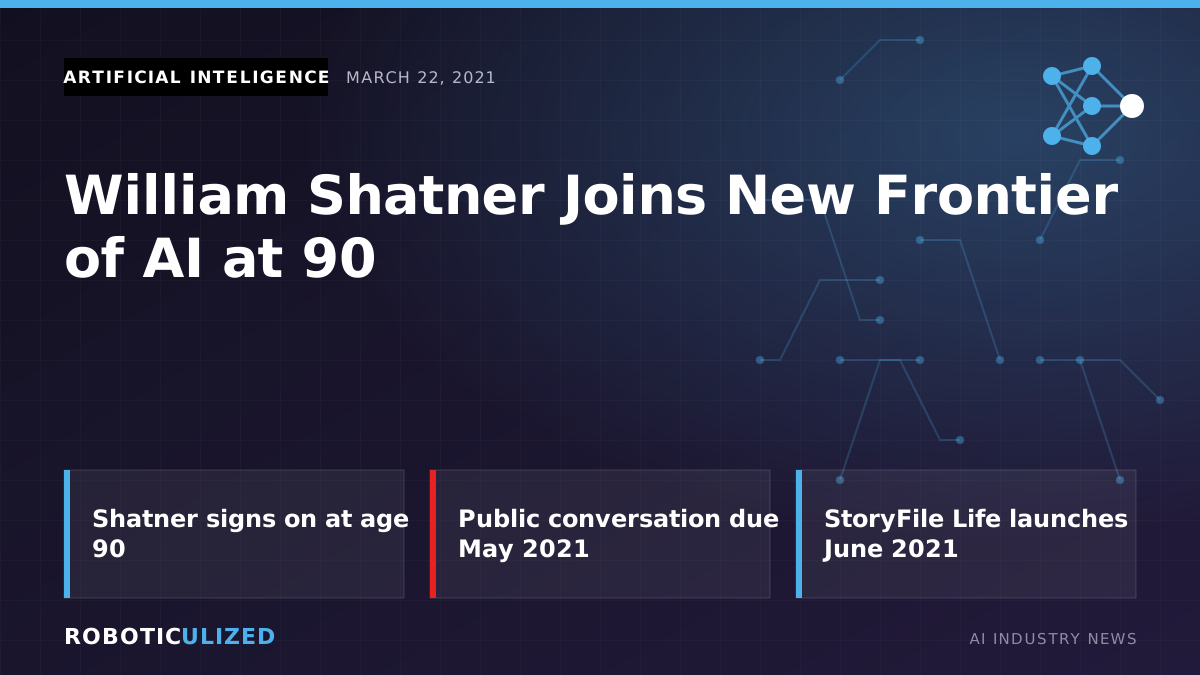
Los Angeles — March 22, 2021 — William Shatner marked his 90th birthday by signing on with StoryFile, a Los Angeles company that builds interactive video conversations driven by artificial intelligence. StoryFile named the actor its brand ambassador. He is also the first person to record a session with StoryFile Life, a consumer product that lets relatives and friends ask him questions and hear his own recorded answers long into the future.
A recorded conversation, not a digital double
StoryFile’s approach differs from the synthetic avatars and face-swapped videos that have drawn attention in recent years. The company does not generate new footage of Shatner. It films him answering a large set of questions, and its software then works out which real clip best answers what a viewer asks. To the person on the other side of the screen, it feels like a back-and-forth exchange with the actor, even though every word on screen is something he actually said.
Heather Maio-Smith, StoryFile’s co-founder and chief executive, made that point when she introduced the project. She said future generations would be talking with the real Shatner, “not an avatar, not a deep fake,” answering their questions himself. She also described the actor, best known as Captain Kirk in Star Trek, as going where no one has gone before.
Shatner described the recording as a present to the people who come after him, a way for them to hear his voice and stories directly. Creating a StoryFile is closer to a long interview than a film shoot: the subject sits in front of cameras and answers question after question about his life, work and views. The result is an archive that can be searched by voice.
The technology behind StoryFile
StoryFile’s sessions run on Conversa, its in-house conversational platform. The underlying system is patented as the “Artificially Intelligent Interactive Memories System” and uses natural language processing to read a spoken question, work out what the speaker means, and pick the most relevant recorded answer from the library.
The company says its conversations are built for connected devices and can also run in virtual and augmented reality, in 3D, and on other digital platforms. StoryFile has made recordings of this kind before, including projects with Time magazine and Microsoft. Last Christmas, during the COVID-19 pandemic, it also released a free AI-powered Santa Claus that families could talk to.
Launch timeline and availability
StoryFile set out a short schedule for both the Shatner recording and the wider product:
- Shatner’s full StoryFile conversation is expected to reach the public on connected devices in May.
- StoryFile Life, the consumer service he is helping to introduce, is scheduled to launch in June.
- A premium tier will be sold by subscription or as a one-time purchase, and free trial versions with limited features will be available.
- Early-adopter pricing applies to people who sign up by March 31, and the service can be bought for oneself or given as a gift.
Co-founder Stephen Smith described the company’s philosophy as a belief that every person’s story deserves to be kept. By choosing Shatner, a performer whose career spans roughly seven decades, StoryFile has a well-known face to show what an interactive memoir can look like.
Why it matters
The announcement shows a split that is opening up in consumer AI video. Generative tools that make convincing fake footage have raised concerns about misinformation and consent. StoryFile is betting on the other path: AI that does not create new content, but finds and plays back material a real person recorded and approved. That design keeps the subject in control of what is said in their name, which matters for memorial and legacy uses.
It is also a sign that natural language understanding is moving out of customer-service bots and voice assistants into more personal areas such as family history, education and remembrance. Whether ordinary consumers will pay to record their own interactive archives is still an open question. A celebrity ambassador and a June consumer launch will give the first real test of demand. If the idea takes off, it could set expectations for how AI deals with a person’s likeness and voice, putting authenticity ahead of synthesis.